How to Homeschool Multiple Kids (Across Different Ages) Without Losing Your Mind
Aug 2026 · 6 min read
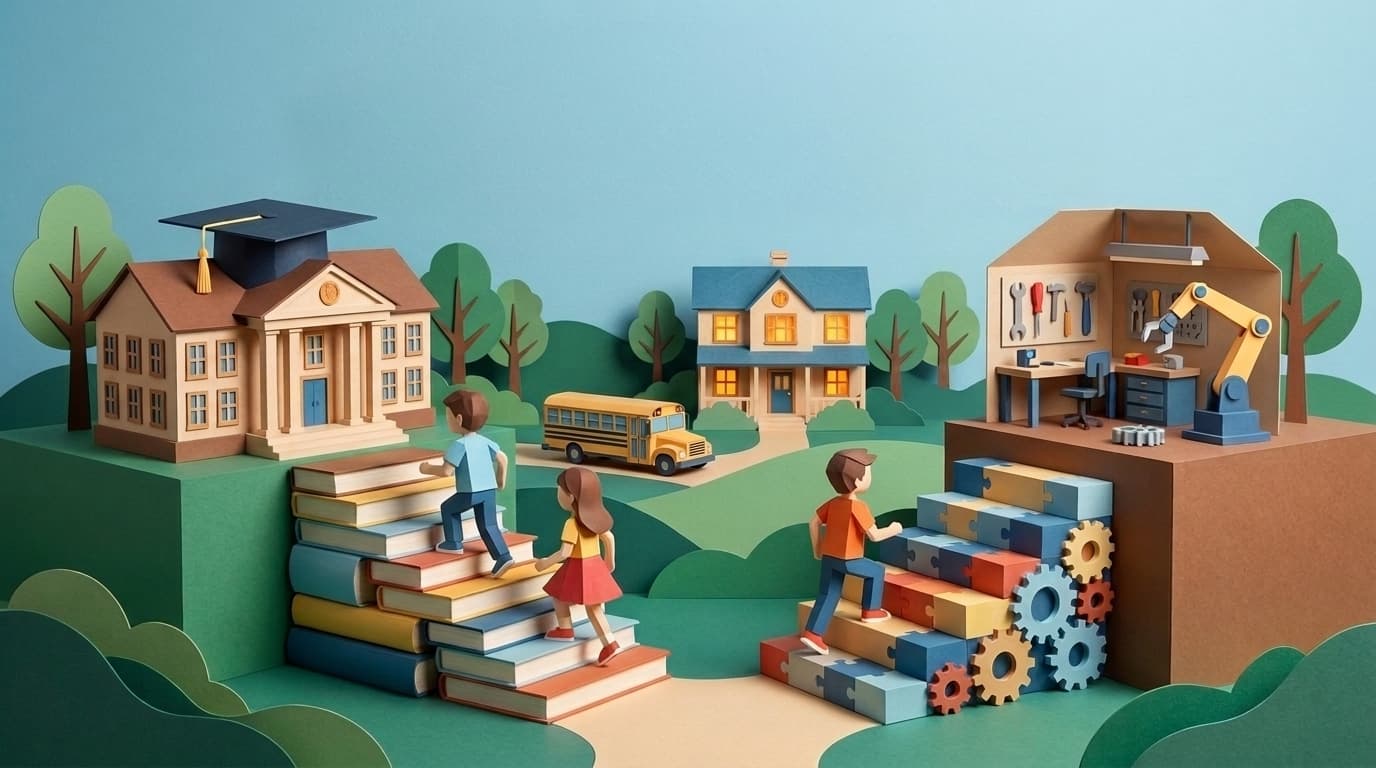
If you're teaching more than one child at home, you already know the chaotic reality of homeschooling across age gaps.
You're trying to explain long division to your 4th grader, your 1st grader needs help sounding out words, and the toddler is actively unrolling an entire roll of paper towels down the hallway.
Trying to run two or three separate, rigid 8-to-3 school schedules at the same time? That's a fast track to complete parent burnout. But homeschooling multiple children doesn't have to feel like air traffic control.
Here's how to streamline your multi-child homeschool using shared rhythms, asynchronous pacing, and smart resource overlap.
1. Shift from Timestamps to "Family Anchor Moments"
When you try to run strict time-blocks — 9:00 AM math for Child A, 9:30 AM phonics for Child B — any tiny delay with one kid completely derails the rest of the day for everyone.
Instead, group your day around shared Anchor Moments:
- Morning Basket / Group Read-Aloud: Gather everyone on the couch for history, poetry, science read-alouds, or Bible study. The older child absorbs the deeper concepts while the younger one engages with the story and imagery.
- Independent Work Blocks: Pair high-touch subjects (like math or phonics) with independent play or quiet reading for siblings. While you work one-on-one with one child, the other is building puzzles, doing quiet activities, or exploring open-ended sensory kits.
- Mid-Day Rhythm: Reconnect for lunch, movement, or outdoor exploration together before diving into afternoon independent learning.
2. Embrace Asynchronous Learning
Children rarely develop at the exact same pace across all subjects. Your 8-year-old might read at a 5th-grade level but still need 2nd-grade math support — and that's completely normal.
Forcing kids into rigid grade-level boxes makes multi-child scheduling harder than it needs to be. Let each child progress asynchronously at their natural pace, without worrying about arbitrary grade labels. One size has never fit all, and it shouldn't have to.
3. Combine Subjects with Multi-Age Unit Studies
You don't need to buy three separate science or history curricula for three kids.
Use Unit Studies to teach one overarching topic — Marine Biology, the Solar System, the Industrial Revolution — to all your children at once:
- The Shared Lesson: Everyone watches the experiment or reads the core book together.
- Differentiated Outputs: Your 6-year-old draws a labeled picture of a whale, while your 10-year-old writes a short research report on ocean zones. Same core topic, age-appropriate output.
One lesson, three kids learning at their own level. That's the sweet spot.
4. Optimize Your Supplies (Buy Less, Learn Together)
You don't need double the subscription boxes or double the curriculum budget. Look for multi-sibling-friendly activity kits and open-ended materials — building sets, nature journals, sensory boxes — that can be shared across age bands.
The best resources grow with your kids instead of getting outgrown by them.
Let LoveLed Harmonize Your Multi-Child Schedule
Tired of juggling conflicting schedules and spending your Sunday nights color-coding spreadsheets?
LoveLed is built specifically for real families. Our philosophy-aware AI engine reasons across sibling profiles — automatically identifying shared learning moments, optimizing your materials budget, and shifting schedules the moment life interrupts.
You focus on the relationships. We'll keep the rhythm.
Ready for a schedule that flexes across every age in your family?